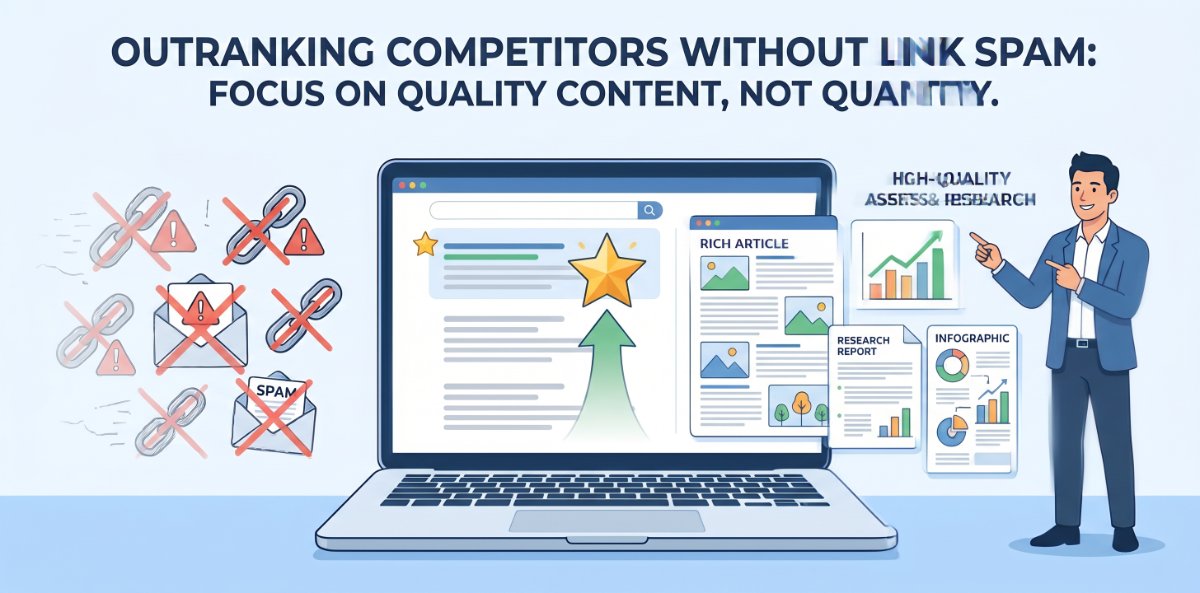
Link spam is the fastest way to tank a site that might otherwise have had a real future. Search engines have become very good at spotting obvious manipulation: rented sidebar links, link farms, random guest posts on irrelevant sites, and “PBNs” that all look like they were built yesterday. The good news is that you no longer need any of that to outrank serious competitors. Real authority now comes from structure, content, experience, and a smaller number of high‑quality signals that actually prove you deserve to rank.
This article looks at how to build that kind of authority so you can win without ever touching a shady link scheme.
Step 1: Make your site the “obvious” answer
The easiest way to earn trust is to look obviously better and more useful than what already ranks. That sounds simple, but very few sites do it deliberately.
Start with a ruthless comparison:
- Open the top 5 results for your main target queries.
- List what they cover: topics, sub‑headings, examples, FAQs, tools.
- List what they miss: nuances, up‑to‑date info, local angle, real examples, visuals, pricing detail, implementation steps.
Then build pages that close those gaps and go wider where it actually helps the user. That might mean:
- Turning a generic “guide” into a full decision framework with examples and templates.
- Adding calculators, checklists, or comparison tables that competitors do not have.
- Updating content more often so you are clearly the freshest, most reliable source.
When your page really is the most complete, clear, and current resource for a topic, you are no longer begging for links. You are creating something that people want to reference.
Step 2: Own a topic, not just a keyword
Most “link building” efforts are trying to patch over a deeper issue: the site does not demonstrate enough expertise on the topic as a whole.
Instead of chasing individual keywords with isolated articles, build topic clusters:
- Choose a core topic that maps directly to what you sell or do.
- Create a pillar page: a deep, comprehensive overview that someone could bookmark and return to.
- Surround it with supporting articles that cover very specific questions, use‑cases, and problems in detail.
- Interlink everything clearly so both users and search engines can follow the logic.
Example: instead of one generic “SEO for dentists” article, a cluster might include:
- The main guide to SEO for dental clinics.
- Separate pieces on local SEO, review management, website structure, and common mistakes.
- Case‑study style stories from different clinic types.
Clusters like this send a much stronger signal of topical authority than a single “best keywords for dentists” post plus a spray of artificial links.
Step 3: Turn your experience into ranking power (E‑E‑A‑T done properly)
Search engines are increasingly looking for signs of real‑world experience and expertise, not just keyword‑stuffed copy. That is an advantage if you have actually done the work you are writing about.
You can surface that experience by:
- Writing from specific scenarios: “here is what we saw after doing X for 27 sites” or “what happened when we tested Y on three different budgets.”
- Using named authors with relevant backgrounds, and giving them proper bio pages that explain why they are credible on the topic.
- Publishing case studies with real numbers (even ranges), timelines, and lessons learned, rather than vague “we helped a client grow.”
- Referencing your own data, tools, or processes rather than only repeating what everyone else already says.
When a page reads like the output of someone who has actually done the thing, it tends to attract more organic links and shares on its own. You are no longer “building” links; you are giving people reasons to talk about you.
Step 4: Build link‑worthy assets instead of begging for links
You can outrank link‑spammers by creating a few genuinely link‑worthy assets instead of dozens of mediocre posts.
Good candidates include:
- Original research or surveys in your niche, even if small‑scale, as long as they are well‑designed and clearly explained.
- Tools and calculators that solve a specific, recurring problem (ROI calculators, sizing tools, checklists, templates).
- Deep reference guides that others in your industry can safely link to as a “definitive” explanation.
If you want these to earn links without spammy outreach, they need two things:
- A clear, memorable angle (for example, “First annual X benchmark” or “The no‑nonsense checklist we wish we had when we started”).
- Easy discoverability: link to them from your main navigation, mention them in relevant articles, and share them with your email list and social audience.
A handful of strong assets like this can attract more natural links over time than hundreds of generic posts ever will.
Step 5: Use outreach as networking, not spam
You do not have to abandon outreach entirely; you just need to stop treating it as a numbers game.
A healthier approach:
- Identify a small list of genuinely relevant sites: industry blogs, newsletters, podcasts, tools, and communities your audience actually uses.
- Spend time understanding their content and audience before making contact.
- Reach out with something specific and useful: an idea for a joint piece, data that supports their work, a missing angle in a popular article, or a resource their audience would genuinely benefit from.
The goal is to build relationships, not “place links.” Those relationships can lead to mentions, co‑marketing, interviews, and partnerships that carry far more weight and risk far fewer penalties than bulk guest posts on random domains.
Step 6: Fix on‑site credibility killers that scare off links
Even if your content is good, other site owners will hesitate to link to you if your site looks untrustworthy or low‑quality at a glance.
Key credibility checks:
- Does your site look modern, clean, and easy to navigate, or does it resemble a template‑spam project?
- Do you have real “About” and “Contact” pages with clear information about who is behind the site?
- Are there obvious intrusive ads, pop‑ups, or auto‑play elements that would embarrass someone who sends their audience to you?
- Is your content clearly dated and updated, or does everything look abandoned?
People link to sites they are comfortable sending their own readers to. Fixing these basics can quietly increase how often you are referenced without any extra outreach.
Step 7: Clean up the risky stuff you already have
If you have dabbled in spammy link tactics in the past, outranking competitors long‑term means cleaning that up rather than piling new links on top.
Steps to take:
- Export your backlink profile from your analytics / SEO tools.
- Identify obviously low‑quality domains: hacked sites, autogenerated blogs, domains with nonsense names, networks where every post is a paid link.
- For the worst offenders, request removal where feasible; if you have a substantial history of aggressive schemes, consider using disavow strategically.
- Stop any ongoing campaigns that generate more of the same: paid link packages, random guest posting services, or private link networks.
The aim is not to have a “perfect” profile, but to remove the clearest liabilities so future updates are less likely to wipe you out.
Step 8: Measure what actually matters (and ignore vanity)
To stay out of the link‑spam mindset, focus on metrics that reflect genuine authority and business impact, not vanity numbers.
Useful metrics:
- Organic traffic and conversions to key pages, not just raw session counts.
- The number and quality of unprompted mentions and links you receive over time.
- Branded searches (people searching for your name or site) as a signal your reputation is growing.
- Engagement metrics: time on page, scroll depth, and return visitors to your most important content.
If those numbers are moving in the right direction, you are building something durable. If they are flat while only “referring domains” creep up from low‑quality sources, you are probably just inflating a risk.
A quick checklist: are you winning without spam?
Use this to check whether you are on a sustainable path:
- Your best‑performing pages are clearly more useful and in‑depth than competitor equivalents.
- You have at least one or two topic clusters that show real breadth and depth.
- Your content reflects real‑world experience, with named authors and specific examples.
- You have at least one asset (tool, guide, research) that others naturally want to reference.
- Outreach is targeted and relationship‑driven, not bulk templated emails.
- Your site looks trustworthy and professional at first glance.
- You are not currently buying links or using obvious artificial networks.
If you can say “yes” to most of those, you are already ahead of many competitors who are still trying to game their way up the SERPs. The power move now is patience: keep doing the right things consistently while others burn themselves on the next quick‑win link scheme.