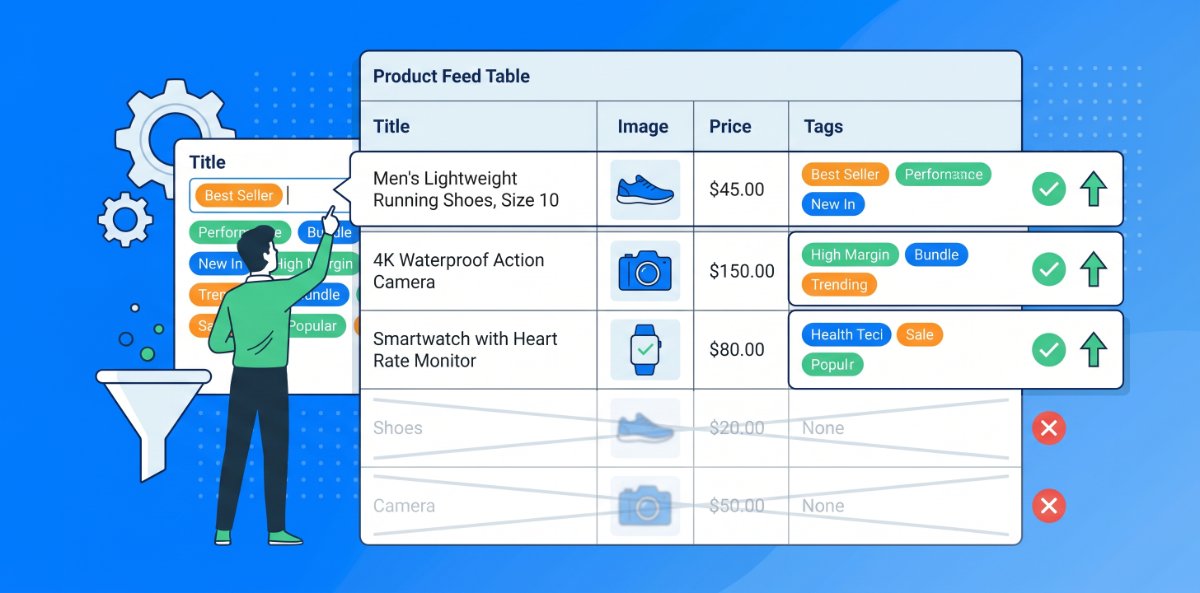
In feed driven channels, titles and tags are the closest thing you have to keywords and ad copy combined. Platforms use them to decide when you appear, for which queries, and in which slots. Get them right and you quietly win more impressions in the right places, often at lower costs. Get them wrong and even good products stay buried, no matter how much budget you pour in.
This post digs into how to structure titles and tags so your products are easier for both algorithms and shoppers to understand.
Step 1 - Think like a searcher, not your PIM
Most bad titles come straight out of internal systems. They are written for warehouses and merch teams, not customers. To fix that, you need to shift perspective from “how we name this SKU” to “how someone would search for it”.
Ask yourself for each product:
- What is it, in plain language?
- Who is it for?
- What is the main use case?
- Which attributes matter most when someone is choosing?
Then rewrite titles with those answers in mind. You are not trying to be poetic. You are trying to make the product instantly recognisable and relevant to search intent.
Step 2 - Use simple, consistent title formulas
Title creativity is overrated. Consistency across a category is far more powerful. A simple formula makes it easier to scale and test.
For example:
- Brand + Product Type + Key Attribute + Use Case + Variant
- “Brand X Women’s Road Running Shoes - Cushioned - UK 6”
- Brand + Core Feature + Product Type + Primary Benefit
- “Brand Y Noise Cancelling Wireless Headphones - 30 Hour Battery”
Within each category, pick one pattern and apply it systematically. That way you can quickly see which pattern performs better if you change it later, instead of every title being a one off.
Step 3 - Front load what matters most
Most platforms truncate titles aggressively. That means you should put the most important words first.
Good practice:
- Start with brand if it is a recognised driver of choice in your niche.
- Lead with product type and key descriptors that match how people search.
- Push less critical details such as pack size, internal codes, or secondary features towards the end.
Your aim is that, even when a title is cut off, the visible part still tells a complete, compelling story.
Step 4 - Separate variants clearly
One quiet killer of impressions and conversions is variant confusion. If every colour or size shares almost identical titles, users and algorithms struggle.
Fix this by:
- Including the differentiating attribute in the title, not only in the attributes section.
- “Brand X Sofa - 3 Seater - Dark Grey Fabric” versus “Brand X Sofa”.
- Making sure variant names are human friendly, not just “Colour 01” or “Size B”.
Clear variant titles help platforms match long tail searches, such as “dark grey 3 seater sofa”, and reduce wasted clicks from people landing on the wrong option.
Step 5 - Use tags and custom labels as targeting tools
Titles help you win the right query. Tags and custom labels help you control how platforms treat groups of products behind the scenes.
Useful tagging strategies include:
- Performance tags such as “best seller”, “low performer”, or “hero product”.
- Margin bands such as “high margin”, “medium margin”, “low margin” to influence bidding.
- Lifecycle tags such as “new in”, “core range”, and “clearance”.
- Seasonal tags such as “summer”, “winter”, “gifting”, “Back to School”.
With these in place, you can build campaigns and rules that push high margin best sellers harder, protect limited stock, and downweight clutter that rarely converts.
Step 6 - Align tags with real marketing decisions
Tags are only useful if they map to decisions you actually make. Before creating another custom label, ask:
- Will this label change how we bid, budget, or build campaigns?
- Will we review performance by this label at least monthly?
- Does the definition stay stable over time, or will it change every week?
It is better to have a handful of powerful labels that drive real choices than dozens that exist only in spreadsheets.
Step 7 - Let performance data refine titles and tags
Titles and tags should not be “set and forget.” Treat them like testable creative.
Simple process:
- Export performance by product and look for patterns: which words, structures, or attributes appear often in top performers.
- Try small changes in title order, phrasing, or included attributes on a subset of products and watch how impressions, click through and conversion change.
- Promote winning patterns across the rest of the category over time.
Do the same with tags. If products tagged as “hero” consistently earn better returns, consider which attributes those products share and whether more items should be tagged similarly.
Step 8 - Avoid keyword stuffing and platform violations
It is tempting to cram titles and tags with every possible keyword. That usually backfires.
Keep to these ground rules:
- Write titles and tags as natural language, not lists of search terms.
- Avoid promotional language in titles where platforms disallow it, such as “free shipping” or “best price”.
- Do not repeat brand and category names excessively; it rarely helps and can hurt quality.
Think clarity first. If a human would find the title annoying or spammy, the algorithm probably will too.
A quick checklist - are your titles and tags working hard enough
Use this as a snapshot of feed quality from a titles and tags perspective:
- Product titles are written for shoppers and search intent, not internal codes.
- Each category uses a simple, consistent naming pattern.
- Key attributes and variants are obvious from the visible part of the title.
- High value products are tagged clearly as best sellers, high margin or hero items.
- Seasonal and lifecycle tags exist so campaigns can pivot quickly.
- You review performance regularly and use it to refine both titles and tags.
When you treat titles and tags like your most compact, high impact pieces of copy and metadata, impressions start to come from the right places more often. That means less wasted spend, steadier click through rates, and more of your budget going towards products and searches that actually move the numbers that matter.