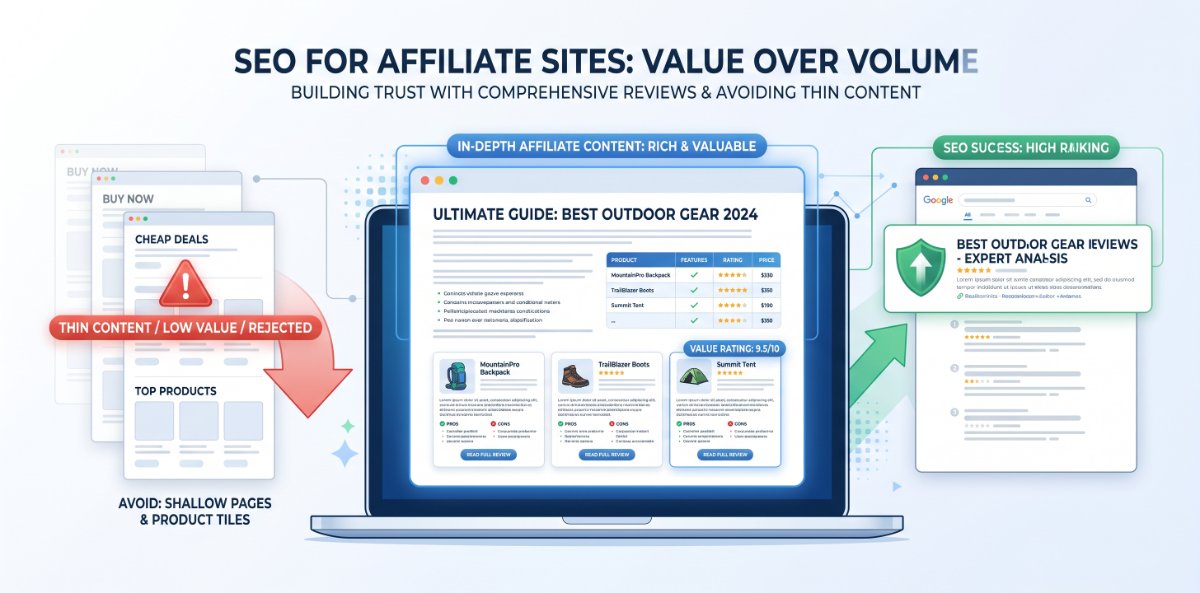
Affiliate sites live under stricter scrutiny than most. Search engines have seen enough low‑effort review farms and coupon scrapers to treat many affiliate projects with suspicion by default. The only reliable way to win is to build something that is clearly useful on its own, even if every affiliate link vanished tomorrow. That means no thin content, no copy‑and‑paste vendor descriptions, and no pages that exist purely as link containers.
This post looks at how to structure an affiliate site so it adds real value, avoids thinness, and significantly reduces the risk of algorithmic penalties.
Start with a real topic, not just a product list
Thin affiliate sites usually start from “What products pay good commission?” and build outward. Strong sites start from “What problems can I help a specific audience solve?” and let products slot into that.
To avoid thinness from day one:
- Choose a defined niche and user: for example, “home coffee enthusiasts in small flats” rather than “kitchen gadgets.”
- Map problems and questions first: how to choose equipment, how to compare options, how to maintain items, how to fix common issues.
- Let products support answers, not become the answer. A guide that genuinely teaches someone how to choose a running shoe, with criteria and trade‑offs, will always beat a listicle that exists purely to drop links.
Search engines do not punish monetisation. They punish pages that offer nothing of substance beyond the monetisation.
Build topical depth instead of one‑off reviews
Thin content often shows up as a scatter of unconnected review pages. Each page targets one product or keyword, but there is no sense of a deeper body of knowledge behind it.
To build topical authority:
- Group content into themes: for example, “Buying Guides,” “How‑To Tutorials,” “Maintenance & Troubleshooting,” “Comparisons,” and “Best Of” round‑ups.
- For each theme, publish multiple pieces that interlink: a main pillar guide plus more detailed sub‑topics that answer very specific questions.
- Make sure informational content (which often has no or very few affiliate links) sits alongside commercial content. That balance signals expertise and user focus.
A site that explains, teaches, compares, and then recommends looks like an expert resource. A site that only recommends looks like an affiliate feed.
Make reviews and “best of” pages genuinely original
Review and comparison pages are where affiliate sites earn most of their revenue, and they are also where thin content is most tempting.
To avoid that trap:
- Do not copy or lightly edit manufacturer descriptions and specs. Summarise in your own words, add context (“this matters if…”) and highlight trade‑offs.
- Add user‑centric criteria. Explain what matters and why: weight, noise, battery life, comfort, ease of setup, long‑term reliability, support.
- Use structure that helps decisions: pros and cons, “good for / not for” sections, and clear comparison tables built from your own criteria, not just vendor bullets.
- Where possible, incorporate genuine usage: your own testing, user feedback, or aggregated ratings from multiple reputable sources. Make it clear how you formed your judgement.
Search engines can recognise when a page is little more than re‑packaged product feed data. Unique analysis and structure are key.
Balance monetised and non‑monetised content
A site where almost every sentence is pushing a link feels thin and self‑serving. A healthier pattern is to make some pages primarily educational, some mixed, and some overtly commercial.
Good signals of balance:
- Informational guides that may mention products but do not rely on them to be useful.
- FAQ‑style content that answers “how,” “why,” and “what if” questions with clear explanations.
- Occasional opinion pieces or deeper explainers on industry changes, standards, or trends relevant to your niche.
When crawlers see a mix of page types, internal links, and content intents, the site looks less like an affiliate shell and more like a specialised publisher that happens to monetise with affiliate links.
Avoid doorway pages and over‑templating
One classic thin‑content pattern is doorway pages: dozens or hundreds of near‑identical pages created just to capture slightly different keywords (e.g. “best X for London,” “best X for Manchester,” “best X for Birmingham,” all with the same text).
To stay on the right side of quality guidelines:
- Avoid spinning out multiple pages where only the city name or one adjective changes. Consolidate into one solid page that genuinely addresses broader intent.
- Be careful with heavy templating. Templates are fine, but each page should have substantial unique content: specific observations, context, examples, and recommendations.
- If you serve multiple regions or audiences, make sure location or segment‑specific pages contain real local nuance (availability, pricing, conditions, regulations), not just swapped labels.
Search engines increasingly detect and devalue pages that look like they were generated to cover every keyword variation without adding new value.
Be transparent with disclosures and intent
Thin, deceptive affiliate pages can trigger both user distrust and quality concerns. Clear disclosure and honest framing do the opposite.
Best practices:
- Put a concise affiliate disclosure near the top of monetised pages, in plain language. Let readers know you may earn a commission and that it does not affect what they pay.
- Avoid implying independence if you are not independent. If you have relationships that might sway recommendations, say so.
- Write recommendations as if you had to defend them to a sceptical, well‑informed reader. That mindset naturally pushes you toward stronger, more balanced content.
Trust is not just ethical; it also correlates with higher engagement, longer dwell time, and better conversion rates, which indirectly help SEO.
Invest in technical and UX quality
Even strong content can be treated poorly if the underlying site feels cheap or dysfunctional. Many affiliate projects underinvest here.
Key points to get right:
- Site speed: keep pages fast, especially on mobile. Heavy scripts, bloated themes, and too many ad units can drag performance down.
- Mobile experience: ensure text is readable, buttons and links are easy to tap, and comparison tables adapt gracefully to smaller screens.
- Navigation and internal linking: organise content by topic and intent so both users and crawlers can find related pages easily.
- Clean design: avoid overwhelming the page with banners, pop‑ups, and auto‑playing elements that distract from the content.
A polished, usable site is more likely to be perceived as legitimate and authoritative, regardless of monetisation.
Use data to identify and fix thin patches
Over time, even good sites accumulate weak pages: outdated guides, thin posts created early, or experiments that never took off. Regularly auditing and pruning them reduces risk.
A simple process:
- Export all pages and look at basic metrics: traffic, engagement (time on page, bounce rates), and conversions.
- Mark pages that get almost no traffic and add little unique value. Decide whether to improve, merge, or remove them.
- Where you have several short or overlapping posts, consider combining them into one stronger, more comprehensive resource.
- Keep an eye on pages that rely heavily on vendor content and gradually replace that with your own summaries and analysis.
This keeps your overall corpus biased toward depth and usefulness rather than sheer page count.
Think like a specialist publisher, not a commission collector
The safest and most profitable affiliate sites tend to behave less like thin affiliates and more like niche media brands. They publish deeply researched pieces, build loyal audiences, and often add extra revenue streams (courses, memberships, products) alongside affiliate income.
If every decision is framed around “Will this actually help my audience make a better decision?” you are unlikely to drift into thin content territory. If decisions are framed around “How can I squeeze in more links?”, thinness becomes almost inevitable.
Over the long term, search engines reward the former far more consistently than the latter.