Budgeting for SEO is not about guessing a number and hoping it works. It is about matching your investment to three things: the size of your business and revenue, how competitive your market is, and how ambitious your growth goals are. Once those are clear, you can decide whether you need a light local push, a serious growth campaign, or an ongoing enterprise‑level program.
Most businesses end up in a few broad ranges. Small, local companies often invest roughly 500–2,000 per month in SEO. Growing national brands commonly sit in the 2,500–10,000 per month bracket, while enterprise or very competitive sectors (legal, finance, SaaS, big e‑commerce) can be 10,000+ per month. The real question is where you should sit on that spectrum and what you expect in return.
Step 1: Decide how important SEO really is
Start with your overall marketing budget. Many companies allocate around 5–10% of revenue to marketing, and then carve out a portion of that for SEO. If organic search is a primary way people find you, 10–20% of your marketing spend going into SEO is common. If it is more of a supporting channel, you might invest a smaller slice.
Ask yourself three questions:
- How many leads or sales do you realistically expect from organic search over the next 12–24 months?
- How dependent are you on search compared with paid ads, referrals, and offline channels?
- What happens to the business if organic traffic drops or never grows beyond today’s level?
If the answers point to SEO being “mission critical”, the budget should reflect that. If SEO is more of a nice‑to‑have, it is fine to keep the spend lean, but expectations must match that choice.
Step 2: Match spend to your business type and competition
Different businesses have very different SEO needs and cost levels. Here is a rough guide:
- Small local businesses (single location, moderate competition): often 500–2,000 per month for local SEO, listings, content basics, and technical clean‑up.
- Multi‑location or competitive local brands: typically 1,500–3,000+ per month to cover multiple locations, stronger content, and a baseline of link building and digital PR.
- Growing national brands and B2B companies: commonly 2,500–10,000 per month for ongoing content creation, technical work, digital PR, and strategic consulting.
- Enterprise or high‑competition verticals (legal, finance, SaaS, large e‑commerce): often 10,000–50,000+ per month when you are fighting well‑funded competitors at scale.
These are not rigid rules, but they give you a reality check. If you are in a very competitive space and the budget you have in mind is far below these ranges, either your goals or your timeline will need to adjust.
Step 3: Understand what you are paying for
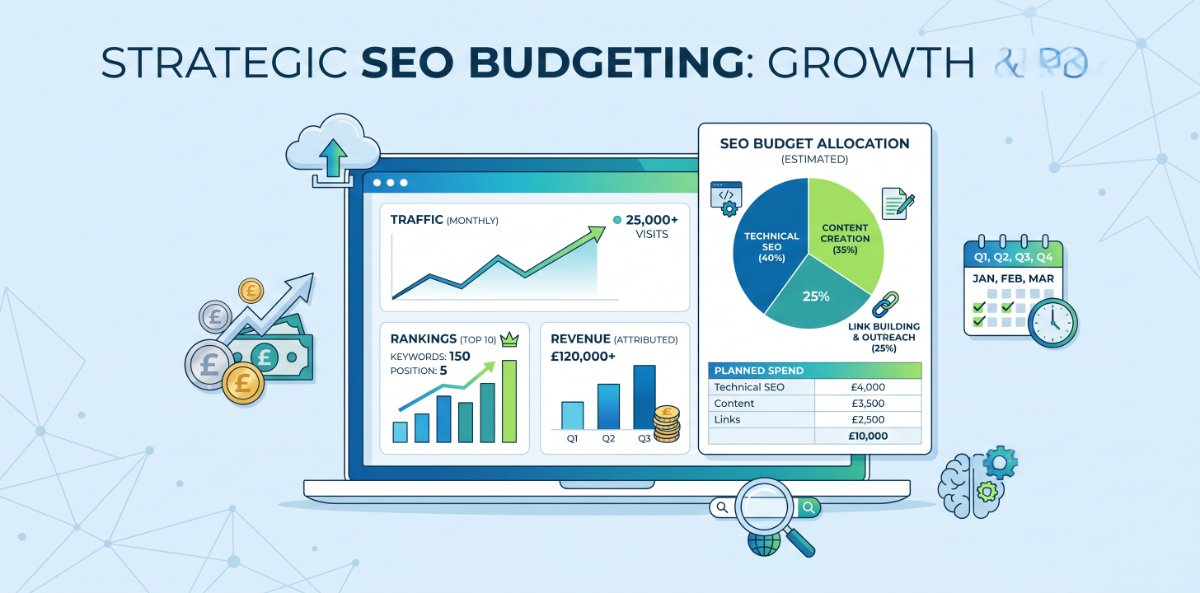
An SEO budget is not just “rankings money.” It usually pays for several categories of work, all of which need some attention if you want real results.
Typical components include:
- Strategy and management: research, planning, prioritisation, reporting, and coordination with your team.
- Technical SEO: audits, fixes, site speed, crawlability, indexation, and support for site changes or migrations.
- Content: keyword research, content strategy, briefs, writing, design, and updates to existing pages.
- Authority and links: digital PR, outreach, and activities that earn high‑quality mentions and backlinks.
- Local SEO: Google Business Profile optimisation, local citations, and locally focused content.
- Tools and data: software for tracking rankings, crawling, log analysis, and competitor research.
A realistic budget gives enough room for at least a few of these streams to run in parallel. If you only fund occasional advice and reports, but no time for actual implementation, you will not see the same impact as a campaign that can fund technical fixes, content, and authority building together.
Step 4: Choose a pricing model that fits how you work
Most businesses engage with SEO using one or more of these models:
- Monthly retainer: a fixed monthly fee (often 1,500–5,000+ per month) for ongoing work. This suits businesses that see SEO as a long‑term channel and want consistent progress and support.
- Project‑based: a one‑off fee, from a few thousand upwards, for specific projects like audits, site rebuilds, or migrations. Good when you need a defined outcome and can handle ongoing work in‑house.
- Hourly consulting: pay by the hour for expert advice, typically used when you have internal resources but need guidance, strategy, or second opinions.
- Hybrid: a stable monthly retainer for ongoing work, with separate project budgets for big jobs like redesigns or large content campaigns.
The key is to match the model to your internal setup. If you want sustained growth and do not have a strong in‑house SEO function, a retainer with clear deliverables often makes more sense than a one‑off audit that nobody ever implements.
Step 5: Plan for a realistic runway, not a one‑month test
SEO is a compounding channel. It usually takes time for technical changes, new content, and authority building to translate into rankings, traffic, and revenue. In many cases, meaningful gains appear after several months of consistent work, especially in competitive markets.
When you budget, think in terms of a runway:
- Commit to a level of monthly spend that you can maintain for at least 6–12 months.
- Set milestones at 3, 6, and 12 months. In the early months, focus on leading indicators like crawl health, rankings, impressions, and clicks. Later, look at leads, sales, and revenue.
- Keep 10–20% of your SEO budget as a flexible buffer for unexpected issues and opportunities, such as algorithm changes, urgent technical fixes, or a campaign you want to amplify.
If you cannot commit beyond one or two months, consider a tightly scoped project instead. A focused, well‑executed audit and fix may be more valuable than spreading a tiny budget over a long period.
Step 6: Build an SEO budget checklist
A simple checklist helps you turn all of this into a repeatable process when you plan budgets each year or quarter.
Before you finalise numbers, ask:
- Have we audited our current SEO performance and technical health in the last 6–12 months?
- Do we know who our real organic competitors are and how aggressively they seem to be investing?
- Are our SEO targets tied to business outcomes (leads, sales, revenue) rather than just rankings?
- Have we chosen a realistic budget range for our size, margin, and competitive landscape?
- Have we decided how that budget will be split between technical work, content, and authority building?
- Do we have clarity on who is doing what: in‑house team, agency, freelancer, or a mix?
If you cannot answer these questions confidently, refine the strategy before locking in numbers.
What “good” SEO budgeting looks like in practice
For a small local service business, “good” might look like this: around 1,000–2,000 per month for 6–12 months, focused on technical clean‑up, a strong local presence (Google Business Profile, citations, local content), and a handful of relevant local links. Expectations are aligned to better local visibility, more calls, and more foot traffic rather than instant dominance in every city.
For a growing B2B company, “good” might be 3,000–7,000 per month. The emphasis is on content (thought leadership, landing pages, comparison pages), technical support for a complex site, plus digital PR and outreach to earn links. Success here is measured in pipeline, qualified leads, and closed revenue from organic.
For an enterprise, a healthy SEO budget usually spans multiple teams, markets, and product lines. There may be dedicated budgets for technical SEO, content production, international SEO, and digital PR. The scale is larger, but the principles are the same: SEO is treated as a strategic, funded channel, not an afterthought.
Across all sizes, the pattern is consistent. The businesses that get the most from SEO are the ones that treat it like any serious investment: they set clear goals, commit to a realistic budget and timeframe, understand where the money goes, and hold themselves and their partners accountable.