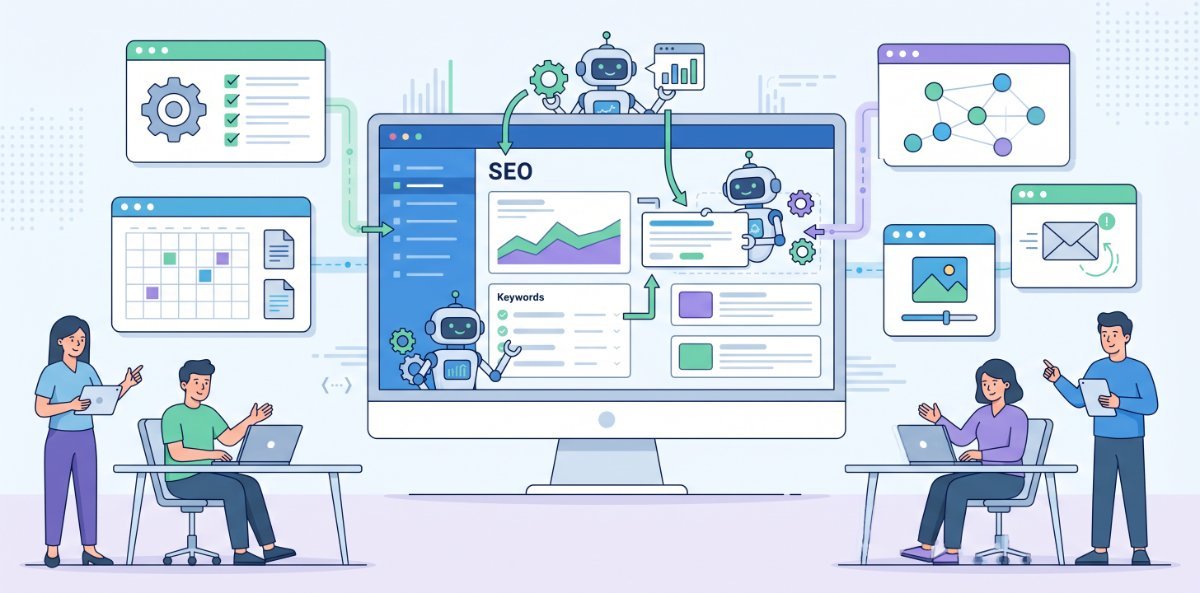
Most SEO teams do not suffer from a lack of ideas. They suffer from a lack of hours. Too much time disappears into dashboards, spreadsheets, and CMS busywork that follows the same pattern week after week. The real opportunity is to automate anything that is structured and repeatable, so humans can stay focused on strategy, creativity, and judgment calls.
Start with the “intern test”
A simple filter helps decide what to automate: would this be safe to hand to a capable intern with clear instructions? If the answer is yes, a senior SEO should probably not be doing it manually every month.
Think about pulling performance data, highlighting pages that are dipping, updating meta fields to a template, or checking for obvious content gaps. Automation should handle roughly the first 70 percent of the work: gathering, sorting, and drafting. Humans then own the final 30 percent: sense‑checking, prioritising, and signing off.
1. Content calendars that build themselves
Most content calendars are stitched together from sitemaps, analytics exports, rank reports, and a handful of “we should really write about X” notes. All of that is highly structured work, which makes it a perfect candidate for automation.
A simple system can combine multiple data sources into a single master sheet, flag URLs due for a refresh based on last update date, and surface content that is losing traffic or conversions. Feed that into an AI workflow and you get a first‑draft calendar that includes topics, proposed titles, and priority tiers. The SEO’s time shifts from hunting for rows to deciding what genuinely matters.
2. Keyword research that starts itself
Manual keyword research often means hours spent deleting noise. Tools spit out huge lists of queries, much of which is too generic, irrelevant, or unworkable. Automation can handle this first pass so humans only review terms that already look promising.
One practical flow: export queries from search console or a keyword tool, sort by modifiers to isolate long‑tail opportunities, then use an AI assistant to cluster keywords, remove obvious junk, and suggest related variants. The result is a cleaner list and a set of topic clusters that invite deeper human analysis, not a wall of raw data.
3. Reports that build and email themselves
No experienced SEO should be hand‑assembling weekly or monthly reports from scratch. The format rarely changes: core KPIs, comparison with the previous period, key movements, and a short commentary.
Dashboards can handle the recurring charts, while automation scripts or AI agents generate concise summaries of trends, call out notable outliers, and draft a stakeholder‑ready narrative. The SEO then edits for nuance, adds context the tools cannot see, and flags what needs action. Time is spent on interpretation, not screenshot collection.
4. Outlines and briefs that arrive half‑done
Writers do their best work when they receive tight, thoughtful briefs. The friction is that building these briefs at scale can swallow a huge portion of an SEO’s week. This is where templates and AI become powerful.
Once standard structures exist for blog posts, product pages, and knowledge‑base content, a repeatable workflow can generate first‑pass outlines using target keywords, example URLs, and intent notes. The SEO refines headings, adjusts scope, and injects the strategic nuance a model cannot guess. Brief creation turns from an hour of grind into a brief review and polish.
5. Content audits that never stop
Traditional content audits are infrequent and exhausting. They produce massive spreadsheets that age quickly and rarely drive continuous action. Continuous, automated auditing is more realistic and more useful.
Crawl data, analytics, and ranking reports can be combined to flag thin pages, stale content, cannibalisation risks, and URLs with falling engagement. An AI layer can group pages into “update,” “merge,” “redirect,” or “keep as is,” leaving the SEO to validate the buckets and decide where to invest effort. The bulk of the sorting happens quietly in the background.
6. Internal links that do not rely on memory
Manual internal linking is a classic time sink. Even the most organised SEO cannot consistently remember every relevant article or evergreen guide that deserves a link. Automation can maintain a far more complete map of opportunities than any individual.
By analysing topics, anchors, and page relationships, tools can propose internal links into new and existing content. An AI assistant can summarise these as simple recommendations, for example: “From these five posts, add contextual links to this new guide using these anchors.” The human then chooses what to accept or edit, instead of combing through the site for every opportunity.
7. Formatting, short codes, and CMS busywork
Many teams still spend hours turning well‑structured content into the precise HTML, blocks, or short codes their CMS requires. This is textbook automation territory and one of the quickest wins.
Spreadsheets, scripts, or custom AI helpers can apply standard markup, build tables, wrap FAQs in the correct schema, and enforce design patterns at scale. Once the logic is encoded, the process becomes consistent and repeatable, removing a constant source of small errors and freeing SEOs from line‑by‑line formatting chores.
8. Documentation that keeps pace with reality
Playbooks, SOPs, and prompt libraries matter, but they are often out of date. Documenting workflows becomes yet another task that never makes it to the top of the list. Automation can help keep the “way we actually work” in sync with reality.
Each time a new prompt, checklist, or process proves valuable, a simple workflow can capture it, add a couple of examples, and file it into a shared knowledge base. Over time, the system evolves into a living manual of the team’s real practices instead of a static PDF no one reads.
9. Technical health checks on autopilot
Technical checks are repetitive by nature. The same crawl configuration, the same filters, the same question: what broke since last week? Running these only when someone remembers almost guarantees that issues are detected late.
Scheduled crawls and automated checks can track 4xx/5xx errors, unexpected noindex tags, canonical changes, and drops in internal links to key pages. Alerts should trigger only when thresholds are crossed, so the SEO’s attention goes straight to genuine problems instead of full reports that hide the signal in noise.
10. Title and meta description testing at scale
Crafting and testing titles and meta descriptions one by one does not scale on large sites. Yet these elements still carry weight for click‑through rates and user expectations. Automation can take over the repetitive parts without losing human oversight.
An AI workflow can generate several options per page following your tone guidelines, keyword targets, and character limits. The SEO then approves or tweaks the variants, while analytics measures performance and feeds learnings back into future suggestions. This makes continuous testing realistic instead of aspirational.
11. Schema generation and validation
Structured data is powerful for visibility and rich results, but it is also fiddly and easy to break. Maintaining accurate schema across hundreds or thousands of pages is not feasible by hand.
Rules can map content types to schema templates, and automation can pull values from your CMS or page content to fill in the details. Regular validation runs can highlight errors, missing fields, or markup that no longer matches the page. Humans step in only where the system flags real issues, instead of sporadically spot‑checking a handful of URLs.
12. Image optimisation that is not an afterthought
Images often arrive in the CMS with random file names, no alt text, and oversized dimensions. This hurts performance, accessibility, and in some cases topical relevance. Automation can enforce better habits quietly in the background.
Standard workflows can rename files according to a convention, compress images to sensible sizes, and draft descriptive alt text based on the page’s headings and context. Editors then approve or adjust the text where nuance is needed, rather than writing everything from scratch.
13. Link monitoring and recovery
Backlink profiles change constantly, but most teams only review them occasionally. That leaves lost links, spam bursts, or unusual shifts hidden until they start showing up in performance.
Automated monitoring can track new and lost links, flag notable changes in referring domains, and group issues that need attention. An AI assistant can even draft tailored outreach for link reclamation or relationship building, with SEOs providing the final personal touch. This keeps link equity healthier without requiring someone to live inside backlink tools.
Keep humans in charge, let machines do the grunt work
The goal is not to turn SEO into a fully automated assembly line. It is to strip out as much repetitive, structured work as possible so specialists can focus on the messy, high‑leverage questions: why a channel is plateauing, how content should evolve with the product, which bets deserve budget, and how to get stakeholders on board.
The most effective approach is incremental. Pick one or two tasks that clearly pass the intern test, automate just enough to save an hour or two each week, and enforce a hard rule that a human reviews everything before it goes live. As those time savings compound, it will become obvious which part of your workflow should be automated next.